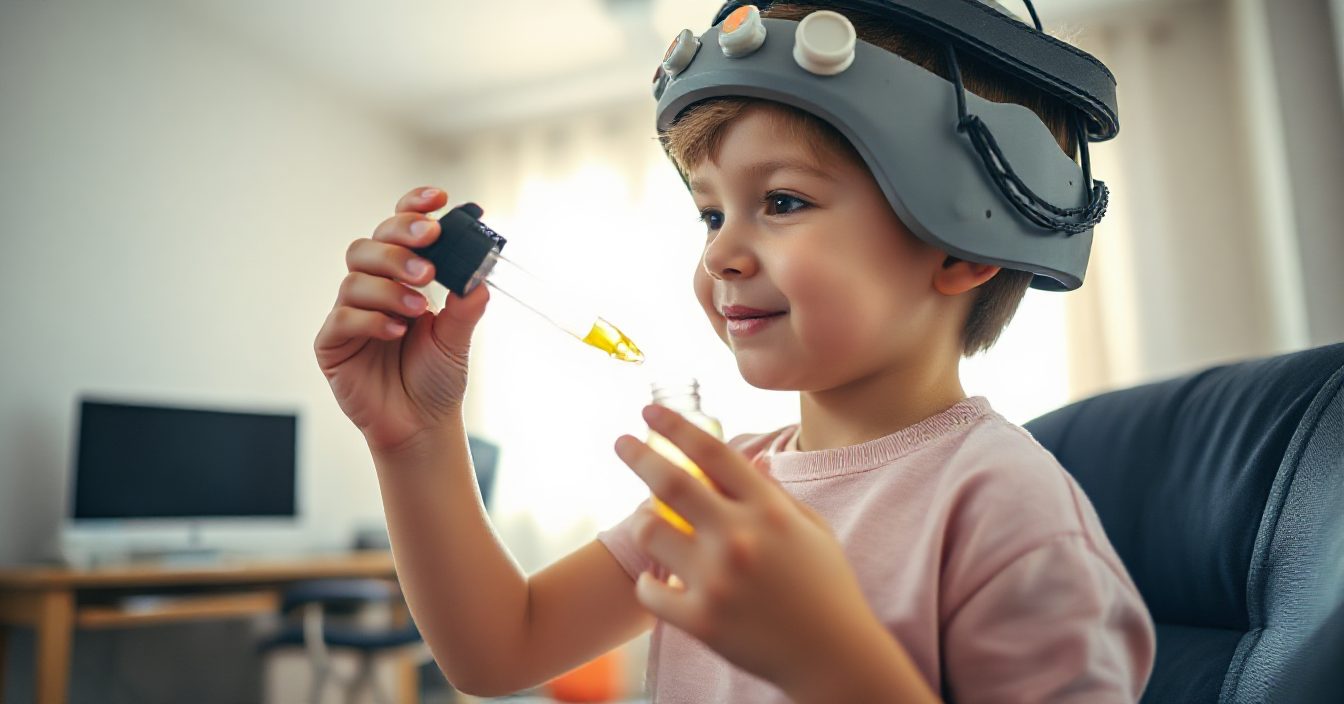
Are you wondering whether CBD oil could help your autistic child's brain work a little more smoothly? It's a fair thing to wonder. You see the hard moments up close, and you want something that might ease them.
So let's look at what the research actually says, and what it doesn't. Then you'll have something steady to stand on before you talk to your doctor.
What the research says so far
Two small studies have asked whether CBD touches the brain in autistic children. Both are early. Both are honest about how much we still don't know.
In a 2026 study by Parrella and colleagues, autistic children ages 5 to 12 took CBD oil for 12 weeks and a placebo for 12 weeks, in random order. Brain recordings at rest came from 18 of them.
After CBD, those children showed stronger beta-band connections between the right frontal and right inferior-parietal areas. The placebo did not show that pattern. The authors call this preliminary and say larger studies are needed to know if it matters in daily life.
In a 2026 study by Cazares and colleagues, researchers looked at 24 boys with autism and higher support needs, ages 7 to 14, who took daily CBD for 8 weeks. Higher CBD levels in their blood were linked with better receptive vocabulary, nonverbal intelligence, and visuomotor coordination.
But the effects were mixed. Some children improved. Others showed little change. That mix is the most important thing to carry with you.
Read the research yourself
You don't need a science degree to read an abstract carefully. A few plain habits go a long way.
- Read it slowly. Note how long the children took CBD and what the researchers actually measured. The headline is rarely the whole story.
- Count the children. The brain results in the Parrella study came from 18 children. A small group can show a signal that fades in larger trials.
- Notice who was studied. The Cazares study looked only at boys with higher support needs. Your child may not match that group, so the findings may not map onto them.
- Expect mixed results. Some children improved and some didn't. A study that says "it depends" is more trustworthy than one promising the moon.
Talk with your doctor
This is not a decision to make alone from a blog post, including this one. Bring the research to someone who knows your child.
- Hand over the link. Copy the PubMed page for the Parrella study and give it to your clinician. A short note with your questions shows you've done your homework.
- Ask about your own child. These studies are about groups. Your doctor can speak to your child's history, other conditions, and anything else they take.
- Ask what to watch for. Ask which changes would matter and which would be a reason to check back in. Let your doctor guide every step.
Track what you actually see
Here is where parents hold real power. You are in the room for the ordinary moments a short appointment never captures.
- Write down small moments. A calmer reaction to a loud room. A longer glance. A rougher afternoon. Note the time and what was happening around it.
- Catch your child's own words. When I brought our log to her psychologist, she asked, "What did your daughter say?" I had to admit I was not tracking that.
- Bring the log to check-ins. A few weeks of plain notes give your doctor something far better than memory. Patterns show up on paper that you'd never spot in the moment.
Keep your hopes honest
CBD is not a magic fix. The research hints it may touch brain networks in autistic children. Whether that helps real life is still an open question.
One study found stronger links between regions tied to attention and social understanding. The other found a tangle of outcomes, with some children helped and some not. Both tell you the same thing. This is early, and it won't look the same for every child.
That's not a reason to feel stuck. It's a reason to move slowly, keep your doctor close, and write down what you see. Clear information and steady notes beat a rushed decision every time.
Have you looked into CBD or another approach for your child's brain and behavior? What made you lean toward it, or away from it? Share your story in the comments.
This article is for general information only. It is not medical advice and is not a substitute for care from your child's doctor or care team. I'm a parent, not a doctor.
Sources
- Parrella, Hill, Enticott, Downey, Catchlove, Ford (2026). Cannabidiol and fronto-parietal EEG connectivity in autistic children. Cerebral cortex. PMID 42981179
- Cazares, Hutton, Paez, Trauner, Voytek (2026). Cannabidiol blood metabolite levels after cannabidiol treatment are associated with broadband EEG changes and improvements in visuomotor and non-verbal cognitive abilities in boys with autism requiring higher levels of support. Translational psychiatry. PMID 41611664